
D-SNP Learning Series: Positioning Your Plan for Success
January–December 2026

Register now
Session 3 | August 19, 2026
Session 4 | November 4, 2026
Overview
In support of DHCS’ goal to expand access to Dual Eligible Special Needs Plans (D-SNPs) for the 1.7 million Californians who are eligible for both Medicare and Medi-Cal, many local plans newly launched D-SNPs, making access to care more integrated and seamless, and simpler to navigate. Individuals who qualify for Medicare and Medi-Cal often have more complex health and social needs, requiring a greater level of coordination across the systems of care with which they engage. Coupled with an increasingly challenging political, regulatory and competitive environment, local plans must pursue and employ strategic, operational and tactical practices and approaches that will sustain and strengthen their D-SNPs.
Join us for our quarterly virtual learning series where local plan leaders, subject matter experts and external partners will share strategic and operational best practices and recommendations to better serve and care for dual eligible members. Developed with support from the California Health Care Foundation and The SCAN Foundation, the series will increase your knowledge and understanding of priority issues, such as quality and Stars performance, risk adjustment and financial sustainability, member experience and growth strategies, and more.
The learning series will run through December 2026.
New Resource: Issue Brief
The LHPC Institute is pleased to announce the release of its new issue brief, Advancing Integrated Care for Dual Eligible Californians: Insights from California’s Local Health Plans.
A culmination of the two-year LHPC Institute D-SNP Learning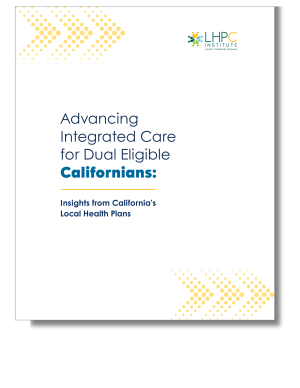 Collaborative, the brief summarizes notable learnings from D-SNP implementation, including key operational and policy challenges, and shares recommendations for stronger coordination between state and federal agencies, and local health plans and providers, all with the goal of improving care for dual eligible members.
Session 3 Agenda
Session 3: Member Experience & Growth and Retention Strategies
August 19, 2026 | 10:00 a.m. – 12:00 p.m.
Jack Dailey, Director of Health Policy/Coordinator of Health Consumer Alliance, Legal Aid Society of San Diego; Gunilla Bergensten, Director of Marketing and Communications, Ricky Flores, Senior Manager, Medicare, and Chau Le, Senior Director, Product and Growth Operations, San Francisco Health Plan
- Role of and services provided by the Medicare and Medi-Cal Ombudsperson Program (MMOP)
- Engaging members and caregivers in designing, participating and assessing their care systems
- Strategies and promising practices for bringing member voices and perspectives into plan governance
- Local plan strategies and approaches for membership growth and retention
Who Should Attend:
This session may be most valuable for local health plan staff responsible for D-SNP member experience, retention and growth, including D-SNP/MA product leads, marketing/communications and enrollment teams, member services, care management/clinical leaders, provider network/contracting, quality/health equity, and analytics staff supporting member insights and outreach.
Previous Agendas
Session 1: Quality & Stars Performance
February 18, 2026 | 10:00 a.m. – 12:00 p.m.
Michael Blatt, Pharm. D., Director of Clinical Pharmacy & Patient Safety, Inland Empire Health Plan; Kailey Collier, Director of Quality Performance and Magdee Hugais, Director of Quality Improvement, Kern Health Systems; Kelli Glynn, MPH, Director III of Quality Initiatives, CalOptima Health
- Implications of the proposed changes to Star measures from the CY 2027 Medicare Advantage and Part D Proposed Rule
- Practical approaches for identifying and prioritizing quality measures
- Key considerations for building an effective Stars strategy that prioritizes improving performance and member experience
- Perspectives from local plans at different stages of D-SNP implementation
Session 2: Risk Adjustment Considerations
July 13, 2026 | 1:00 – 3:00 p.m.
Melissa Hugo, Medicare Risk Adjustment Director, San Francisco Health Plan, Teresa Mason, Partner, Epstein Becker & Green, P.C., Katie-Elyse Turner, Director of Financial Planning & Analysis, Health Plan of San Mateo
- Examining CMS’ risk adjustment payment methodology
- Hierarchical Condition Category coding essentials
- Current federal enforcement priorities
- What comprises a successful compliant risk adjustment program
- Perspectives and best practices from experienced local plans
Learning Series Faculty
Gunilla Bergensten
Director of Marketing and Communications
San Francisco Health Plan
Michael Blatt, Pharm. D.
Director of Clinical Pharmacy & Patient Safety
Inland Empire Health Plan
Athena Chapman
President
Chapman Consulting LLC
Kailey Collier
Director of Quality Performance
Kern Health Systems
Jack Dailey
Director of Health Policy/Coordinator of Health Consumer Alliance
Legal Aid Society of San Diego
Kelli Glynn, MPH
Director III of Quality Initiatives
CalOptima Health
Ricky Flores
Senior Manager, Medicare
San Francisco Health Plan
Magdee Hugais
Director of Quality Improvement
Kern Health Systems
Melissa Hugo
Medicare Risk Adjustment Director
San Francisco Health Plan
Chau Le
Senior Director, Product and Growth Operations
San Francisco Health Plan
Teresa Mason
Partner
Epstein Becker & Green, P.C.
Rebecca Sullivan
Director of Government Affairs, CalAIM & MLTSS
Local Health Plans of California
Katie-Elyse Turner
Director of Financial Planning & Analysis
Health Plan of San Mateo
Registration
This learning series is developed with support from the California Health Care Foundation and The SCAN Foundation. Participation in the series is complimentary; however, registration is required.
The series will accommodate up to 300 participants per session. Registration will close after the deadline or once the seat limit has been reached.
Registration for Session 3 closes Aug. 14 at 5:00 p.m.
Participating in the Webinar: You will only need a computer with an updated web browser (Google Chrome, Microsoft Edge, Mozilla Firefox or Safari are recommended). Participants may opt to listen to the webinar via telephone or device.